
Memory Foam Mattress for Back Pain: Complete Buying Guide (2026)

Quick Answer: Memory foam mattresses are effective for back pain relief by providing pressure point relief and maintaining spinal alignment. They contour to your body’s shape, reducing pressure on shoulders and hips, while a denser support layer prevents the spine from sinking into an unnatural curve.
- Memory foam offers pressure relief and spinal alignment.
- Medium-firm is ideal for most sleepers.
- Open-cell foam sleeps cooler than closed-cell.
- Proper care extends mattress lifespan to 7-10 years.
Waking up with a stiff back or aching shoulders is one of the most common complaints linked to an old, sagging mattress. If you’ve been searching for the right memory foam mattress for back pain, you’ve probably noticed there’s no shortage of options – but not all memory foam mattresses are built the same. This guide breaks down exactly what to look for, how memory foam helps with back pain, and how to choose the right one for your needs.
Table of Contents
- How Your Mattress Affects Back Pain
- How a Memory Foam Mattress for Back Pain Works
- Open-Cell vs Closed-Cell Memory Foam
- Key Features to Look For
- Memory Foam vs Spring and Coir Mattresses
- Choosing Firmness Based on Sleeping Position
- How Long Does a Memory Foam Mattress Last?
- Caring for Your Memory Foam Mattress
- Our Recommendation
- FAQs
- Conclusion
How Your Mattress Affects Back Pain
Most people don’t connect their morning backache to the mattress they slept on – but an unsupportive sleep surface is one of the most common, fixable causes of chronic back discomfort. A mattress that’s too soft lets your spine sink out of alignment, while one that’s too hard creates pressure points at the shoulders and hips, both of which can leave the lower back compensating all night.
According to the Sleep Foundation, mattresses designed specifically to relieve back pain typically combine cushioning at pressure points with firmer support through the lumbar region – a balance that memory foam is particularly good at achieving.
How a Memory Foam Mattress for Back Pain Works
A well-made memory foam mattress for back pain works on two principles: pressure relief and spinal alignment.
Pressure Point Relief
Memory foam is temperature-sensitive and conforms closely to your body’s shape, gradually moulding around the heavier parts of your body – shoulders, hips, and lower back – rather than pushing back against them. This reduces the sharp pressure points that often cause tossing and turning.
Spinal Alignment
While the top layer contours to your body, a denser support layer underneath keeps your spine from sinking into an unnatural curve. This combination – soft on top, firm underneath – is what allows memory foam mattresses to feel comfortable while still keeping your back properly supported through the night.
Open-Cell vs Closed-Cell Memory Foam
Not all memory foam is built the same way, and the difference matters more than most shoppers realise.
Closed-cell memory foam has a denser, more uniform structure. It contours well but can trap heat, since air doesn’t move through it easily.
Open-cell memory foam has a more porous internal structure, which allows air to circulate through the foam itself. This generally makes open-cell foam mattresses sleep cooler than traditional memory foam, while still offering the same pressure-relieving contouring – a useful feature in India’s warmer climate.
Key Features to Look For in a Memory Foam Mattress for Back Pain
Firmness Level
Most orthopedic memory foam mattresses for back pain fall in the medium-firm range – soft enough to relieve pressure points, firm enough to prevent your hips from sinking too deep.
Foam Density and Thickness
A mattress around 6 inches thick is generally considered a good balance for back support – thick enough to prevent “bottoming out” (feeling the hard base through the foam), without being unnecessarily bulky.
Motion Isolation (Zero Disturbance)
If you share your bed, motion isolation matters. A “zero disturbance” design means movement on one side of the mattress doesn’t transfer across to disturb your partner – a hallmark feature of quality memory foam.
Breathability and Cooling
Open-cell foam, breathable knit covers, and high-GSM fabric all contribute to how cool a memory foam mattress sleeps – an important consideration if you tend to sleep hot.
Cover Fabric (GSM)
GSM (grams per square metre) measures fabric density. A higher GSM cover tends to feel softer and more durable against repeated use and washing.
Warranty
Memory foam mattresses with longer warranties (8-10+ years) generally indicate the manufacturer has confidence in the foam’s durability against sagging and indentation over time.
Memory Foam vs Spring and Coir Mattresses for Back Pain
Traditional coir (coconut fibre) mattresses are firm and durable but offer little contouring – they support the spine but can create pressure points at the shoulders and hips for side sleepers. Spring mattresses offer more bounce and airflow but can develop uneven support as springs wear unevenly over time.
Memory foam sits between these two: it offers contouring that springs and coir can’t match, while a quality support layer underneath prevents the excessive sinkage that gives memory foam mattresses a bad reputation when poorly made. For people specifically dealing with back pain, a well-constructed orthopedic memory foam mattress is generally considered a strong option by sleep health resources, including the Sleep Foundation’s guide to mattresses for back pain.
Choosing Firmness Based on Sleeping Position
Your preferred sleeping position changes what “the right firmness” means for your back:
- Back sleepers: Medium-firm mattresses support the natural curve of the spine without letting the lower back sink too deep.
- Side sleepers: Slightly softer mattresses help cushion the shoulders and hips, preventing pressure point pain.
- Stomach sleepers: Firmer mattresses help prevent the midsection from sinking, which can otherwise strain the lower back.
- Combination sleepers: A medium-firm option offers the best balance across positions.
How Long Does a Memory Foam Mattress Last?
A good-quality memory foam mattress typically lasts 7-10 years with proper care, though this depends heavily on foam density and how it’s maintained. Lower-density foams tend to develop visible indentations sooner, especially in frequently-used areas. Rotating the mattress periodically (head to foot) can help distribute wear more evenly over its lifespan.
Caring for Your Memory Foam Mattress
- Use a mattress protector: This prevents spills, sweat, and dust from reaching the foam directly, which can otherwise affect both hygiene and foam lifespan.
- Avoid folding or bending: Unlike cotton floor mattresses, memory foam should be stored flat to avoid permanent creasing.
- Allow it to air out: New memory foam mattresses can have an initial odour (off-gassing) – airing the room for the first day or two helps this dissipate.
- Rotate periodically: Rotating head-to-foot every few months helps even out wear patterns.
- Keep it on a supportive base: A slatted or solid base appropriate for foam mattresses helps maintain even support and prevents premature sagging.
Our Recommendation
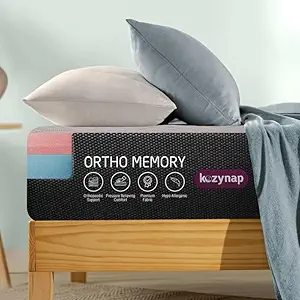
If you’re specifically looking for an orthopedic memory foam mattress built around back pain relief, the KozyNap Orthopedic Open-Cell Memory Foam Mattress checks the key boxes covered in this guide – open-cell foam construction for better airflow, a zero-disturbance design for shared beds, a high-GSM fabric cover, and a 10-year warranty, in a 6-inch profile suited to single beds (72x30x6 inch).
For more sizes and types, browse our full Mattresses collection.
Memory Foam Density Explained: What the Numbers Mean
Foam density is measured in kg per cubic metre (kg/m³) and is one of the most important – and most overlooked – specifications when choosing a memory foam mattress for back pain.
- Low density foams tend to feel softer initially but lose their shape faster, developing indentations within a year or two of regular use.
- Medium density foams offer a balance of comfort and durability, making them suitable for most households and the most common choice for orthopedic mattresses in this price range.
- High density foams last longer and offer firmer support, but can feel less plush and may retain more heat unless paired with open-cell construction or cooling covers.
For back pain specifically, medium-to-high density foam in the support layer – combined with a softer comfort layer on top – tends to offer the best long-term results, since the support layer is what prevents the spine from sinking out of alignment over months of use.
Common Memory Foam Mattress Myths
A few misconceptions often influence buying decisions more than they should:
- “Memory foam is always too hot to sleep on.” This was true of older, closed-cell foams, but open-cell construction and breathable covers have significantly reduced heat retention in modern memory foam mattresses.
- “Firmer is always better for back pain.” An overly firm mattress can create pressure points at the shoulders and hips, which can indirectly strain the lower back as your body compensates. Medium-firm is usually the better starting point.
- “All memory foam mattresses feel the same.” Foam density, layer thickness, and cover fabric all significantly change how a mattress feels and performs – two mattresses both labelled “memory foam” can feel completely different.
- “A thicker mattress is always more supportive.” Thickness alone doesn’t determine support – a thick mattress made entirely of low-density foam can still sag. The construction of the layers matters more than total height.
Setting Up Your Memory Foam Mattress for the First Time
Memory foam mattresses are often compressed and rolled for shipping, which means a little patience is needed after unboxing:
- Unroll on a flat, supportive surface – ideally the bed base where it will be used, since moving it after full expansion is harder.
- Allow 24-48 hours to fully expand – the foam will continue to rise and firm up over the first day or two.
- Air out the room during this period, as a mild initial odour from the compressed foam is normal and dissipates within a few days.
- Use a fitted sheet and protector only after the mattress has fully expanded, to ensure a proper fit.
Choosing the Right Size for Your Memory Foam Mattress
Mattress size affects both comfort and how the mattress performs for back support. A single-size memory foam mattress (commonly around 72×30 inches) is a popular choice for individual sleepers, students, and smaller bedrooms, while also being budget-friendly compared to larger sizes.
If you’re buying specifically for back pain relief and sleep alone, a single or twin size in a 6-inch profile is often sufficient to deliver the contouring and support benefits of memory foam without the higher cost of a queen or king mattress. Couples, however, should generally look at queen or king sizes to ensure motion isolation features like “zero disturbance” can be fully effective – a single mattress shared by two people limits how much benefit those features provide.
Whatever size you choose, make sure your bed frame or base properly supports the full length and width of the mattress – gaps or unsupported edges can lead to uneven wear over time, which defeats the purpose of choosing an orthopedic design in the first place.
Frequently Asked Questions
<!– wp:rank-math/faq-block {"listStyle":"","textAlign":"left","titleWrapper":"h3","listCssClasses":"","titleCssClasses":"","contentCssClasses":"","questions":[{"id":"faq-question-6a2fd1e75dc32","visible":true,"title":"Is a memory foam mattress good for back pain?","content":"Yes, when it’s well constructed with a contouring top layer and a supportive base layer, memory foam can help relieve pressure points while keeping the spine aligned, which is why it’s commonly recommended for back pain.
“},{“id”:”faq-question-6a2fd1e75dc39″,”visible”:true,”title”:”What thickness of memory foam mattress is best for back pain?”,”content”:”Around 6 inches is generally a good balance – enough cushioning for pressure relief without losing firm support underneath.
“},{“id”:”faq-question-6a2fd1e75dc3b”,”visible”:true,”title”:”Does open-cell memory foam sleep cooler than regular memory foam?”,”content”:”Yes, the porous structure of open-cell foam allows more airflow through the material, which generally helps it sleep cooler than denser, closed-cell memory foam.
“},{“id”:”faq-question-6a2fd1e75dc3c”,”visible”:true,”title”:”How firm should a mattress be for back pain?”,”content”:”Medium-firm is generally recommended as a starting point, though side sleepers may prefer a slightly softer feel and stomach sleepers a firmer one.
“},{“id”:”faq-question-6a2fd1e75dc3d”,”visible”:true,”title”:”What does “zero disturbance” mean in a mattress?”,”content”:”It refers to motion isolation – movement on one side of the bed isn’t transferred across the mattress, so a restless partner is less likely to disturb your sleep.
“},{“id”:”faq-question-6a2fd1e75dc3e”,”visible”:true,”title”:”How often should I replace a memory foam mattress?”,”content”:”Most memory foam mattresses last 7-10 years with proper care, though visible sagging or indentations are a sign it may be time to replace it sooner.
“}],”className”:””} –>Is a memory foam mattress good for back pain?
Yes, when it’s well constructed with a contouring top layer and a supportive base layer, memory foam can help relieve pressure points while keeping the spine aligned, which is why it’s commonly recommended for back pain.
What thickness of memory foam mattress is best for back pain?
Around 6 inches is generally a good balance – enough cushioning for pressure relief without losing firm support underneath.
Does open-cell memory foam sleep cooler than regular memory foam?
Yes, the porous structure of open-cell foam allows more airflow through the material, which generally helps it sleep cooler than denser, closed-cell memory foam.
How firm should a mattress be for back pain?
Medium-firm is generally recommended as a starting point, though side sleepers may prefer a slightly softer feel and stomach sleepers a firmer one.
What does “zero disturbance” mean in a mattress?
It refers to motion isolation – movement on one side of the bed isn’t transferred across the mattress, so a restless partner is less likely to disturb your sleep.
How often should I replace a memory foam mattress?
Most memory foam mattresses last 7-10 years with proper care, though visible sagging or indentations are a sign it may be time to replace it sooner.
Conclusion
Choosing the right memory foam mattress for back pain comes down to a few key factors: medium-firm support, a foam construction that balances contouring with durability, breathability suited to your climate, and a warranty that reflects the manufacturer’s confidence in the product. If you’ve been waking up with back stiffness, an orthopedic open-cell memory foam mattress with a zero-disturbance design is one of the most effective upgrades you can make to your sleep setup.
Many sleepers notice a difference within the very first week of switching to a proper orthopedic memory foam mattress, making it one of the more cost-effective upgrades for long-term back health.