
Pocket Spring Mattress Buying Guide: What Every First-Time Buyer in India Should Know

Quick Answer: A pocket spring mattress features individually fabric-wrapped coils that compress independently, offering superior motion isolation, contouring, and airflow compared to other types. This makes it ideal for couples, hot sleepers, and those seeking balanced support and comfort.
- Individually wrapped coils provide better motion isolation.
- Offers superior airflow, ideal for hot climates.
- Provides zoned support for different body areas.
- Combines spring support with foam comfort.
This pocket spring mattress buying guide covers everything a first-time buyer needs before purchasing. A pocket spring mattress uses individually fabric-wrapped coils that compress independently, giving better motion isolation, contouring, and airflow than bonded foam or Bonnell spring mattresses — making it the best all-round choice for couples, hot sleepers, and anyone who wants spring-level support with foam-level comfort. Before you buy one, though, you need to understand coil count, gauge, layering, and how pocket springs behave in Indian heat and humidity, because not all “pocket spring” mattresses are built the same. This guide covers what actually matters.
Table of Contents
- Quick Comparison: Pocket Spring vs Bonnell Spring vs Foam
- What Is a Pocket Spring Mattress, Exactly
- Coil Count and Gauge: What the Numbers Mean
- Why the Comfort Layer Matters as Much as the Springs
- Real Benefits of Pocket Springs for Indian Homes
- Who Should Buy a Pocket Spring Mattress
- Who Should Consider Alternatives
- A Practical Buying Checklist
- Maintenance and Lifespan in Indian Climate
- Our Pick: Centuary Sleepables Pocket Spring Queen Mattress
- Frequently Asked Questions
- Conclusion
Quick Comparison: Pocket Spring vs Bonnell Spring vs Foam
| Factor | Pocket Spring | Bonnell Spring | Memory/PU Foam |
|---|---|---|---|
| Motion isolation | Excellent — springs move independently | Poor — interconnected coils transfer movement | Good, but can feel like sinking together |
| Airflow/cooling | Very good — open coil structure | Good | Poor to moderate, heat retention common |
| Back/spinal support | Very good, contours per body zone | Moderate, uniform support only | Good if high-density, poor if cheap foam |
| Price band (queen, India) | Rs 12,000 – Rs 35,000+ | Rs 6,000 – Rs 15,000 | Rs 8,000 – Rs 30,000+ |
| Best for | Couples, hot sleepers, back support seekers | Budget buyers, guest rooms | Solo sleepers, pressure-point relief needs |
| Typical lifespan | 8-10 years | 5-7 years | 6-8 years |
Why This Pocket Spring Mattress Buying Guide Matters
Skipping straight to a product listing without understanding coil count, gauge, and comfort layers is how buyers end up disappointed within a year. This pocket spring mattress buying guide walks through each spec in plain language.
What Is a Pocket Spring Mattress, Exactly
A pocket spring mattress contains hundreds of individual steel coils, each sewn into its own fabric pocket, arranged in a grid across the mattress. Because each coil is independent, it compresses only under the exact point of pressure — your hip, shoulder, or lower back — rather than pulling down a whole connected wire network the way a Bonnell spring mattress does. This is the core difference that makes pocket springs feel more like they “contour” to your body while still offering the bounce and support that pure foam cannot replicate.
A typical queen pocket spring mattress like the Centuary Sleepables (75x60x6 inches) contains anywhere from 300 to 600+ coils depending on the model and firmness target, topped with comfort layers of foam, fibre, or quilted padding that determine the surface feel.
Coil Count and Gauge: What the Numbers Mean
Coil Count
More coils generally means finer-grained support — the mattress can respond to smaller areas of the body independently. For a queen mattress, look for at least 300-400 pocket springs; premium options run 500-800+. However, coil count alone does not determine quality; a mattress with 800 thin, low-gauge coils can feel worse than one with 400 well-tempered coils.
Wire Gauge
Gauge refers to the thickness of the steel wire, usually ranging 13-15 gauge in Indian mattresses. Lower gauge numbers mean thicker, firmer wire. A firmer gauge suits heavier body weights or those wanting more orthopedic support, while a higher gauge (thinner wire) gives a plusher, softer feel suited to lighter sleepers.
Zoning
Better pocket spring mattresses use zoned coil arrangements — firmer coils under the lumbar/hip region, softer coils under the shoulders — to keep the spine aligned regardless of sleep position. Ask specifically whether a model has zoned support before buying, since not all pocket spring mattresses do.
Why the Comfort Layer Matters as Much as the Springs
The springs provide support; the layers on top determine comfort and feel. Common comfort layer combinations in Indian pocket spring mattresses include:
- PU foam quilting – budget-friendly, moderate breathability.
- Memory foam top layer – adds pressure relief but can trap heat if not gel-infused or open-cell.
- Natural or synthetic latex – excellent breathability and bounce, resists dust mites better than foam.
- Fibre/cotton quilting – breathable and traditional, softer initial feel but compresses faster over years.
A pocket spring core paired with a thin, low-quality foam layer will still feel mediocre. When evaluating a pocket spring mattress, ask what the top comfort layer is made of and how thick it is (ideally 1-2 inches minimum for noticeable pressure relief).
Real Benefits of Pocket Springs for Indian Homes
n
Independent sleep research bodies such as the Sleep Foundation’s research on mattress support and back pain similarly note that individually wrapped coils outperform interconnected coil systems on motion isolation, which lines up with what Indian pocket spring buyers report in daily use.
Better Airflow in Hot, Humid Climates
The open coil structure allows air to move through the mattress core, which matters significantly in Indian summers and humid coastal regions where all-foam mattresses can feel like sleeping on a heat trap. This airflow also helps the mattress dry out faster after humidity exposure, reducing mould risk compared to dense foam blocks.
Motion Isolation for Couples
Because each coil compresses independently, a partner tossing and turning on one side of the bed does not create a ripple effect that disturbs the other side — a major quality-of-life improvement for light sleepers sharing a bed.
Durable Edge Support
Many pocket spring mattresses reinforce the perimeter with higher-gauge coils, which helps when sitting on the edge of the bed to put on shoes or when two people sleep close to opposite edges on a queen or king mattress.
Who Should Buy a Pocket Spring Mattress
Pocket springs suit couples who sleep at different times or move differently at night, anyone in a hot or humid region who has struggled with heat retention on foam mattresses, and back pain sufferers who need zone-specific support rather than uniform firmness. They are also a solid middle-ground choice if you cannot decide between “too soft” foam and “too hard” coir, since a good pocket spring mattress with a foam or latex layer sits comfortably in between.
Who Should Consider Alternatives
If budget is the primary constraint, a well-made Bonnell spring or firm coir mattress may deliver adequate support at a lower price point, especially for guest rooms or growing children’s beds where premium motion isolation is less critical. Those with a strong preference for a “hugging” memory foam feel with zero bounce may also prefer a dedicated memory foam mattress over a pocket spring hybrid.
Pocket Spring Mattress Buying Guide: A Practical Checklist
- Confirm coil count and gauge, and ask if the design is zoned.
- Check comfort layer material and thickness (foam, latex, or fibre).
- Verify the mattress height/profile fits your existing bed frame or divan.
- Check warranty length — pocket spring mattresses typically carry 7-10 year warranties from reputable Indian brands.
- Look for a removable, washable outer cover, which matters in humid climates.
- Ask about the trial/return period in case the firmness does not suit you after a few nights.
Maintenance and Lifespan in Indian Climate
Pocket spring mattresses generally last 8-10 years with proper care, but Indian humidity and monsoon conditions can shorten this if maintenance is neglected. Rotate the mattress head-to-foot every 2-3 months to prevent uneven coil compression. Use a breathable, waterproof protector rather than plastic sheeting, since plastic traps moisture against the coils and comfort layer, encouraging mildew. Avoid folding or bending a pocket spring mattress sharply during transport, as this can damage individual coil pockets. During monsoon months, keep the bedroom ventilated and avoid placing the bed directly against an exterior wall prone to dampness.
Our Pick: Centuary Sleepables Pocket Spring Queen Mattress
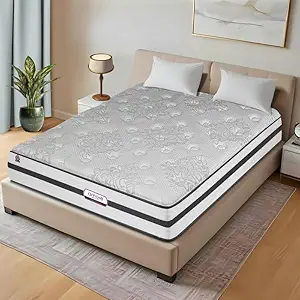
The Centuary Sleepables Pocket Spring Queen Mattress (75x60x6) is a well-balanced example of the category: individually wrapped coils for motion isolation and zone support, in a queen footprint that fits most Indian bedrooms without the cost premium of a king. Centuary is one of India’s established mattress manufacturers with decades of spring-mattress engineering experience, which shows in the coil consistency and edge support of this model. If you have been going back and forth between foam and spring, this is a practical middle-ground pick that avoids the heat-retention complaints common with all-foam mattresses while still offering contouring comfort.
For a deeper look at this specific model’s build and firmness rating, read our Centuary Sleepables Pocket Spring Queen Mattress Review, or explore other spring options in our mattress collection.
Choosing Firmness Based on Body Weight and Sleep Position
Coil count and gauge only matter in the context of who is actually sleeping on the mattress. A pocket spring mattress that feels perfectly supportive for a 55 kg side sleeper can feel unsupportive and “bottom out” under a 90 kg back sleeper, because the coil compression threshold is calibrated to a weight range.
Lighter Sleepers (Under 60 kg)
Look for higher-gauge (thinner) coils and a plusher comfort layer, since heavier-gauge springs may feel too rigid and prevent proper contouring at the shoulders and hips.
Average Weight Sleepers (60-90 kg)
Most standard pocket spring mattresses in the medium-firm range are calibrated for this bracket, which is why it is the most common firmness sold in India. A 300-500 coil count with a 1-1.5 inch foam or latex comfort layer typically works well here.
Heavier Sleepers (Over 90 kg)
Look specifically for lower-gauge (thicker) coils, higher coil counts for better weight distribution, and a firmer overall rating, since insufficient support here leads to faster sagging and premature spinal misalignment.
Side Sleepers
Side sleepers put concentrated pressure on the shoulder and hip, so a slightly softer comfort layer over firm zoned springs helps prevent pressure points, which is a common complaint with all-foam mattresses that are too firm at the surface.
Back and Stomach Sleepers
These positions need firmer, more even support to prevent the lower back from sinking out of alignment, so a medium-firm to firm pocket spring mattress with strong lumbar zoning works best.
Common Mistakes First-Time Pocket Spring Buyers Make
After the coil count and comfort layer are sorted, most buying mistakes come down to a handful of avoidable errors:
- Buying based on “pocket spring” labelling alone without checking coil count, gauge, or comfort layer thickness — two mattresses can carry the same label and feel completely different.
- Ignoring the base/frame requirement — placing a pocket spring mattress on an unsupportive or uneven slatted base accelerates sagging regardless of the mattress’s own quality.
- Skipping the trial period — firmness perception changes after a few nights of actual sleep, so always check the retailer’s trial or return policy before assuming the showroom feel will match home use.
- Overlooking warranty terms — check whether the warranty covers sagging beyond a specific depth (commonly 1.5-2 inches) and whether it requires proof of using a compatible base.
- Forgetting to measure the room and doorway —Pocket spring mattresses are more rigid than foam and cannot be rolled or heavily compressed for tight doorway transport, so measure before ordering, not after delivery.
Frequently Asked Questions
What is the difference between pocket spring and Bonnell spring mattresses?
Pocket springs are individually wrapped and compress independently for zone-specific support and better motion isolation. Bonnell springs are interconnected coils that move together, offering more uniform but less contoured support at a lower price.
How many coils should a good queen pocket spring mattress have?
Look for at least 300-400 pocket springs in a queen size mattress; premium models offer 500-800+ for finer support granularity.
Do pocket spring mattresses sleep cooler than memory foam?
Yes, generally. The open coil structure allows more airflow through the mattress core compared to dense memory foam, which retains body heat unless it is gel-infused or open-cell.
How long do pocket spring mattresses last in Indian conditions?
With proper rotation and a waterproof protector, a good pocket spring mattress lasts 8-10 years, though high humidity without adequate ventilation can shorten this.
Is a pocket spring mattress good for back pain?
Yes, especially zoned pocket spring designs that offer firmer support under the lumbar region and softer give under the shoulders, keeping the spine aligned through the night.
Can a pocket spring mattress be used with any bed frame?
Most pocket spring mattresses work on slatted frames, divans, or solid platform bases, but always check the recommended base type, since inadequate support under the mattress can accelerate coil wear.
Why do pocket spring mattresses cost more than basic foam?
The manufacturing process of individually wrapping hundreds of coils in fabric pockets is more labour and material intensive than pouring a foam block, which is reflected in the price but also in the durability and support quality.
Conclusion
A pocket spring mattress is one of the few mattress types that genuinely balances support, comfort, and climate suitability for Indian homes, provided you check coil count, gauge, and comfort layer quality rather than buying on the “pocket spring” label alone. If you want a queen-size mattress that delivers on all three, the Centuary Sleepables Pocket Spring Queen Mattress is a well-engineered, climate-appropriate choice backed by an established Indian manufacturer.